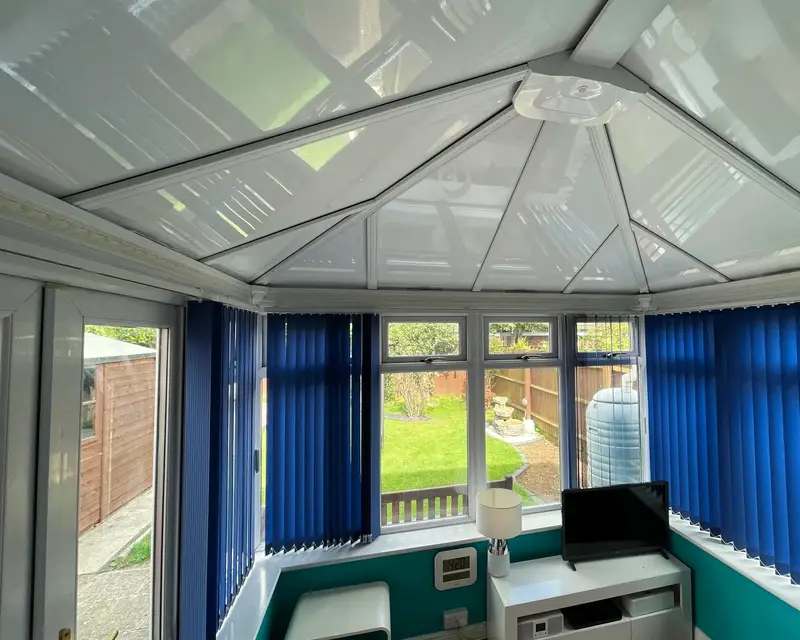
Why a kit appeals
The appeal is easy to see. A lining blocks the sun before it reaches the floor, so the room heats up far more slowly on a bright day. It adds a layer between you and the cold in January. Some kits are sold for DIY, and a fitted one is still usually well below the price of a new roof. It also looks like a ceiling straight away, which beats staring at grimy flutes.
If your polycarbonate is young, sound and watertight, and you simply want shade, a lining is not a silly idea. The trouble starts when the roof above is old, which is when most people go looking for one.
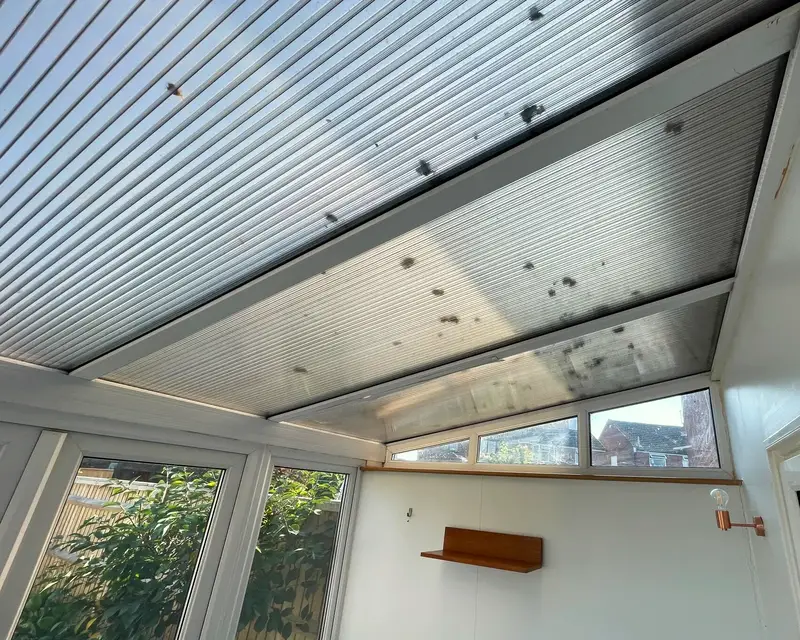
Where the moisture goes
A conservatory holds a lot of water vapour: from breathing, plants, cooking next door and laundry drying on a rack. Warm air carries that vapour upwards. In an unlined room it meets the cold roof, forms droplets and runs to the gutter or drips, which you can see and wipe.
Add a lining and the vapour still gets through gaps at the edges, staples and joints, then condenses on the cold sheets in a space you cannot see. With no airflow it stays wet. Over a few winters that can mean black mould on the back of the lining, a musty smell and stains spreading through the new ceiling. If you are already noticing that smell, our answer on why a conservatory smells damp is worth reading.
How damp builds up behind a lining
- Warm, moist air risesEveryday living puts vapour into the room air, and it drifts to the ceiling.
- It slips past the liningEdges, staples and joints let some through into the hidden gap.
- It meets the cold sheetsOn a winter night the old roof is near outdoor temperature, so the vapour turns to water.
- It has nowhere to goNo air moves in the gap, so the water sits and feeds mould.
The failing sheets stay overhead
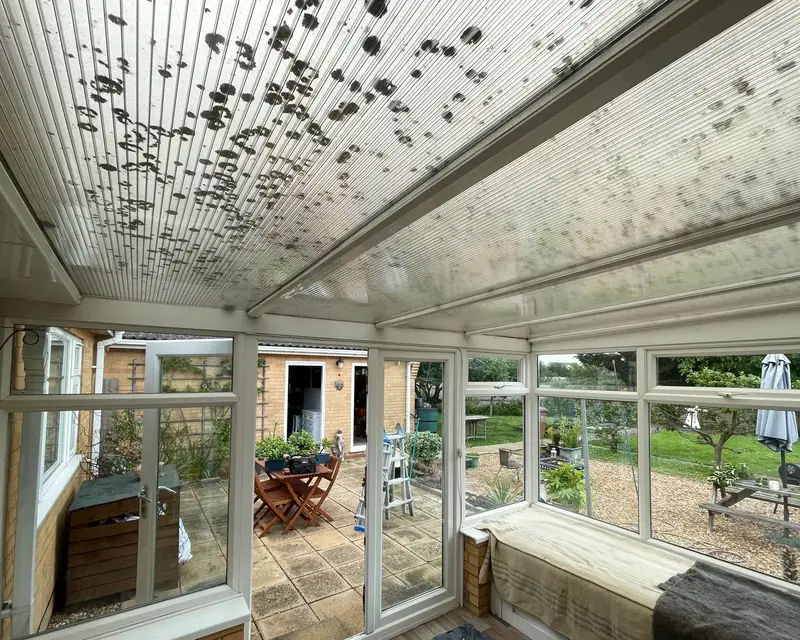
A lining does nothing for the outer roof. If the sheets leak today, they will leak tomorrow, only now the water lands on the back of your new ceiling. Moss and leaf litter keep building up outside. UV keeps breaking down the plastic. And rain still hammers the sheets: a lining softens the drumming but does not stop it, because the noise starts on the outside face.
Weight matters too. Glazing bars and polycarbonate were sized to carry light sheets, snow and a little wind. Hanging battens and boards from them adds a load they were never meant to take. If the roof is dripping now, our page on a dripping conservatory ceiling covers the likely causes first.
Kit and new roof compared
Our panel roof prices by room size give the other half of this sum.
| Insulation kit under old roof | New insulated panel roof | |
|---|---|---|
| Cost | Usually a fraction of a new roof | From £3,000 for a small room |
| Winter warmth | Better than bare polycarbonate, depends on fit | U about 0.43 across the whole roof |
| Summer heat | Much less sun reaches the room | 317 too-warm waking hours a year in our model |
| Daylight | None through the roof | None through the roof, unless roof lights are added |
| Rain noise | Softened, still there | A soft patter |
| Lifespan | Tied to the old roof above it | New roof, 10 year guarantee |
| Upkeep | Outer roof still needs clearing; hidden damp risk | Rinse and clear gutters |
How a replacement handles the same problems
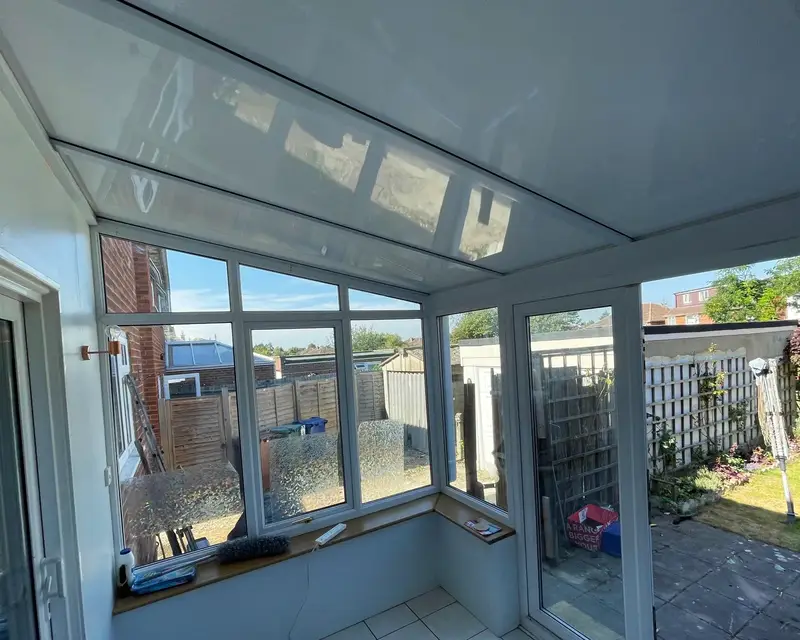
A panel roof takes the old sheets away rather than covering them. The 75 mm foam core sits between two aluminium skins, so there is no hidden cold layer for vapour to find: the warm side and the cold side are sealed to each other. The underside is the finished white ceiling.
In the Comfort Calendar model that roof turns 1,320 too-warm waking hours under polycarbonate into 317, and gives you about 1,003 more waking hours a year when the room is fit to sit in. You can run the conservatory temperature calculator for your town.
Which way to go
A kit is a patch for a roof with life left in it. A new roof is for one that has given up. If you are not sure which yours is, ask for a free survey and we will tell you honestly.
An insulation kit can work if
- The outer roof is under ten years old and dry
- You mainly want summer shade
- The room is well aired and rarely damp
- You need a stopgap for a year or two
Replace the roof instead if
- The sheets leak, sag or have turned yellow
- There is moss, condensation or a damp smell
- Rain noise is a big part of the problem
- You want a ceiling that will not hide trouble