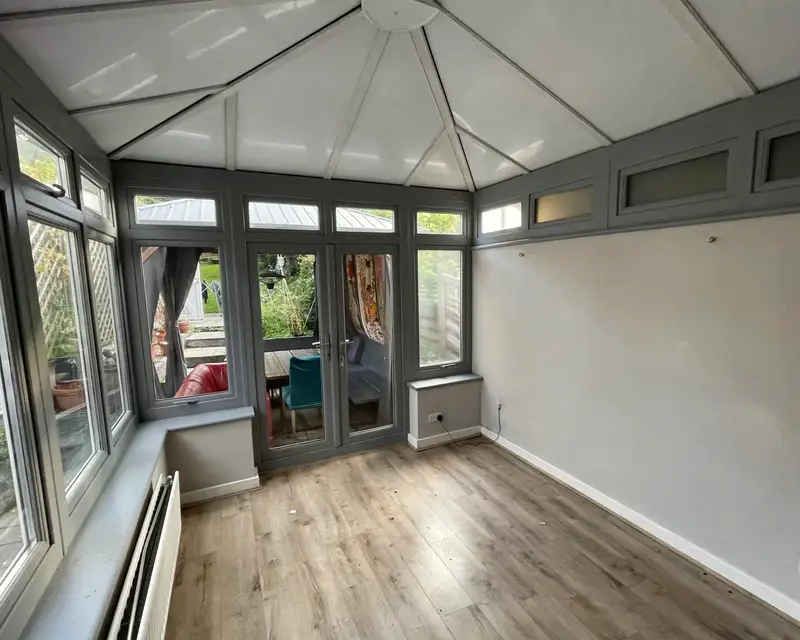
The five places the smell usually starts
Mould needs three things: moisture, something to feed on (dust, fabric, timber, the film of grime on old sheets) and a few days without drying out. A conservatory is very good at supplying all three between October and April, when the room is shut up and rarely heated.
| Tell tale sign | What fixes it | |
|---|---|---|
| Condensation on the roof | Drips or a wet sheen on the ceiling on cold mornings | Warmer roof surface, more ventilation |
| Water inside the sheets | Green or black lines running down the flutes | Replacing the sheets; they cannot be dried out |
| Leaking seals or bars | Wet patches after rain, stains along a glazing bar | Resealing, or a new roof if the seals are tired all over |
| Damp dwarf wall | Flaking paint or a tide mark low on the brickwork | Clearing soil and paving away from the wall, a damp specialist |
| Soft furnishings | Smell strongest close to cushions, rugs or curtains | Drying them out, lifting rugs, airing the room |
Why the roof is so often the culprit
Warm air carries more invisible water than cold air. Chill it against something cold enough and it has to drop the surplus, which is why a can from the fridge goes wet in your hand. In a glazed room the coldest surfaces are the roof and the glass, and the roof is the larger of the two and the hardest to wipe.
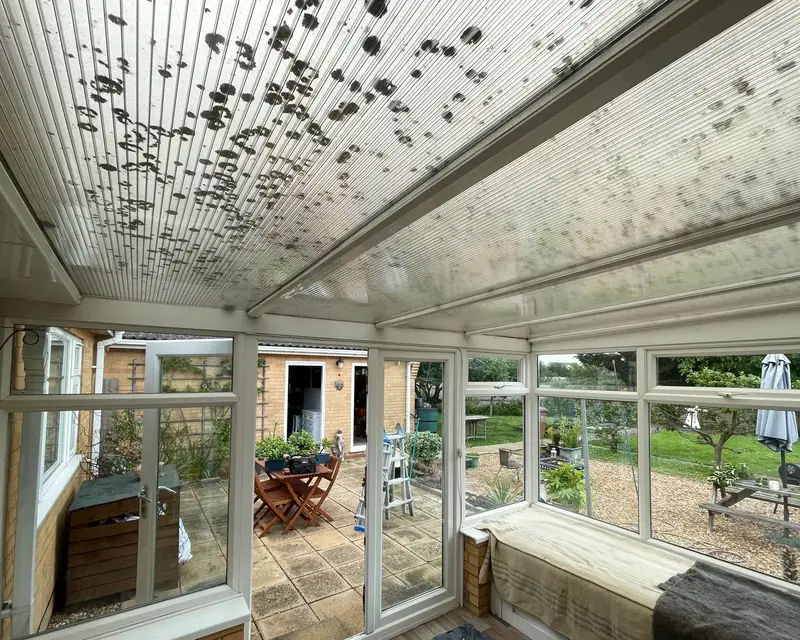
Polycarbonate adds a second problem. Multiwall sheets are full of hollow channels called flutes. When the breather tape along the lower edge of a sheet perishes, water and spores get inside the flutes and cannot get out. Those dark stripes running down the slope are colonies living inside the plastic, and scrubbing the outside never reaches them. Our page on a dirty conservatory roof shows what can and cannot be cleaned.
Tracking it down in an afternoon
Work through these in order. Each one takes a few minutes, and most people find the cause by step three.
Finding the source of a damp smell
- Sniff low, then highKneel by the dwarf wall and the floor edges, then stand on a step under the roof. The smell is strongest closest to the source.
- Check on a cold morningBefore you open anything, look for drips, beads on the glass and a wet sheen on the ceiling. That is condensation.
- Look up after rainWet patches or drips that only appear after a downpour point to a leak at a bar, a seal or the wall flashing.
- Lift the rug and cushionsFeel the underside of rugs, seat pads and the backs of curtains for coolness and a musty edge.
- Check the outside wall lineSoil, gravel or paving piled up against the dwarf wall lets ground water soak into the brick.
Quick fixes that cost nothing
- Open a window or the trickle vents for twenty minutes each morning, even in winter. Damp air out, dry air in.
- Stop drying washing in the room unless a window is open or a dehumidifier is running. A load of laundry releases litres of water as it dries.
- Wipe the overnight water off the glass and the bars first thing, before it soaks into the seals.
- Pull furniture a hand's width off the glass and the dwarf wall so air can move behind it.
- Group fewer plants together and water them in the morning, not at night.
A small dehumidifier is worth having for the first winter while you work out the cause. If the tank fills every day, the moisture source is inside the room; if the smell persists with an empty tank, look at the roof and walls.
What a new roof does, and what it does not
A panel roof deals with the two roof causes in one go. The old sheets and their soaked flutes go away on the day, and the new ceiling stays warm enough that moisture no longer settles on it. Our model shows the room is easier to keep warm in winter too: the heater needed to hold 19°C when it is 0°C outside falls from 1.7 kW to 1.1 kW, so a little heat keeps the whole room above its dew point.
A roof will not fix rising damp in the dwarf wall, a bridged damp course, or a garden bed piled against the brickwork. The glass walls also stay glass and can still mist on cold mornings, so the morning airing habit is still worth keeping. If water is coming through the ceiling rather than condensing on it, see our page on a dripping conservatory ceiling, and if you are wondering whether your sheets are past saving, read how old your conservatory roof is next.
Sorted by a panel roof
- Condensation dripping from the ceiling
- Mould growing inside old flutes
- Leaks from tired roof seals and bars
- A cold room that never dries out
Needs a different fix
- Rising damp in the dwarf wall
- Soil or paving above the damp course
- Washing dried indoors with the room shut
- Wet rugs over a cold floor