Start with the paperwork
A few minutes in the drawer where the house papers live can save a lot of guessing. Look for:
- An invoice or guarantee from the company that built the conservatory. Even if that company no longer trades, the date is still useful.
- The home buyer's survey or valuation from when you moved in. Surveyors often note the conservatory and roughly when it was added.
- The estate agent's listing, if you kept it. Photos show whether the conservatory was already there.
- Old family photos of the garden. A conservatory that appears between two summers dates itself.
If the previous owners are reachable, a quick message is often the fastest answer of all.
Clues written on the roof itself
No papers? The roof often tells you more than you expect. Look up from inside with a torch on a dull day, when glare will not hide the detail.
| Clue | Where to look | What it tells you |
|---|---|---|
| Date on the spacer bar | The metal or plastic strip separating the two panes | Often the month and year the unit was made |
| Sheet thickness | The edge of a polycarbonate sheet at the gutter end | 16 mm sheets are typical of older builds; 25 and 35 mm came later |
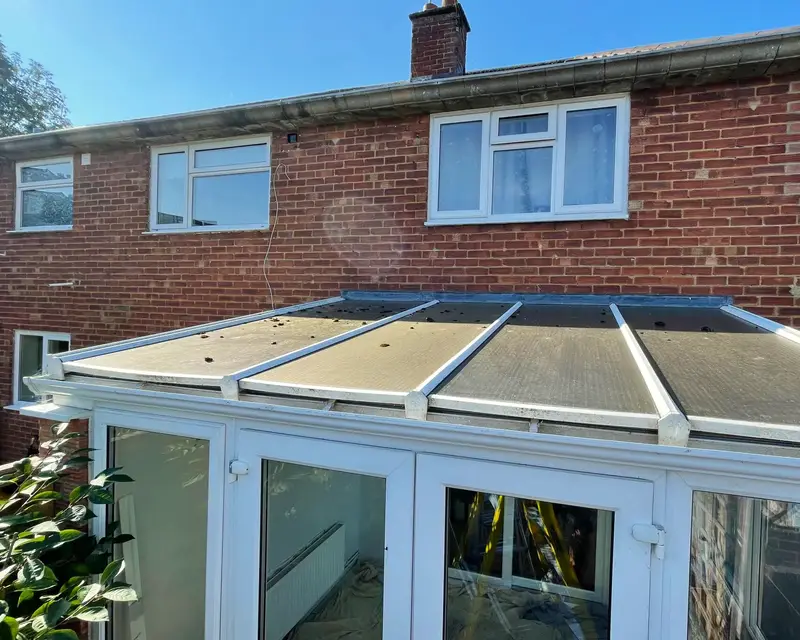
| Colour of the sheets | Looking up at the roof on a bright day | A yellow or brown cast develops over years of sun |
| Ribbed or bronze sheets | Outside, on older lean-tos | Common on conservatories added in the 1980s and 1990s |
| Frame material | The glazing bars and ridge | Timber or aluminium bars usually predate a uPVC frame |
Wear that shows a roof is near the end
Age in years is a rough guide. What really matters is whether the roof still keeps out water and holds heat. These are the signs that it no longer does:
- Dark lines inside the flutes. Once dirt and algae are inside a polycarbonate sheet, the seals at the ends have failed. Our page on a dirty conservatory roof shows what that looks like.
- Misting between the panes. On a glass roof, condensation trapped between the two sheets means the unit's seal has gone and its insulating gap is filling with damp air.
- Yellowing and brittleness. Sun slowly breaks down polycarbonate. A sheet that cracks when a branch lands on it has had its day. See discoloured polycarbonate.
- Drips after rain. Shrunken gaskets and perished sealant along the bars let water through.
- Rattling caps and loose trims. Heard on windy nights, a sign the fixings have loosened over the years.
How age shows up in the temperature
A roof does not just look older; it performs worse. A 25 mm polycarbonate sheet in good condition has a U-value around 1.6, but our model uses 2.4 for a tired one, because water in the flutes and failed seals let more heat through. Older double glazed roof units from the 1990s and 2000s sit around 2.8.
In that state, our model finds the roof responsible for 41% of the room's heat loss in winter and the main route for summer heat. A south facing room under it reaches 47°C at its hottest hour of an average year. You can see the month by month picture for your town in the Comfort Calendar.
- 47°C
- hottest hour under a tired polycarbonate roof
- 41%
- of winter heat loss through that roof
- 34°C
- hottest hour once a panel roof is fitted
What to do with the answer
If your roof is young and sound, a clean and a check of the seals may be all it needs. If it shows several of the signs above, the frame is often still in good shape even when the sheets are not, and that is what our surveyor checks first. A panel roof is fitted onto the frame you already have once it passes. Guide prices begin at £3,000 for the smallest size band, and the prices page shows the rest.