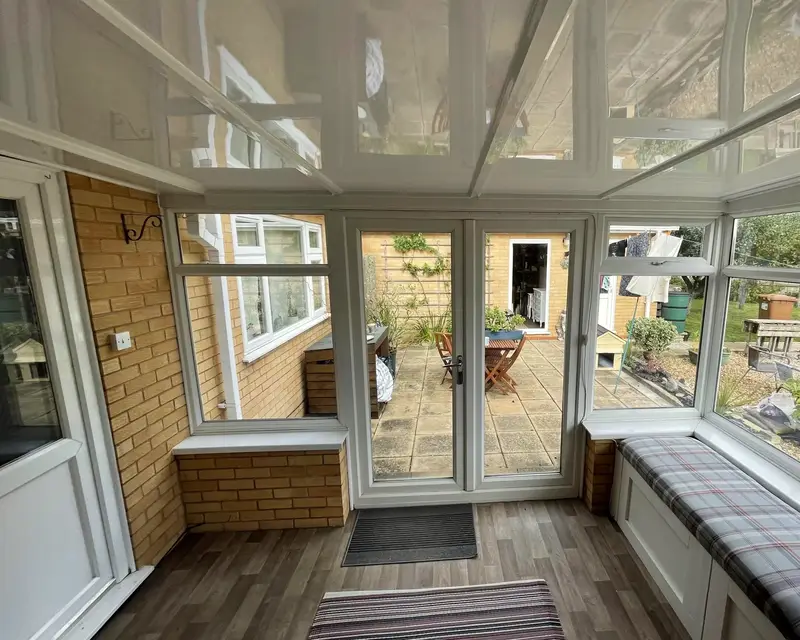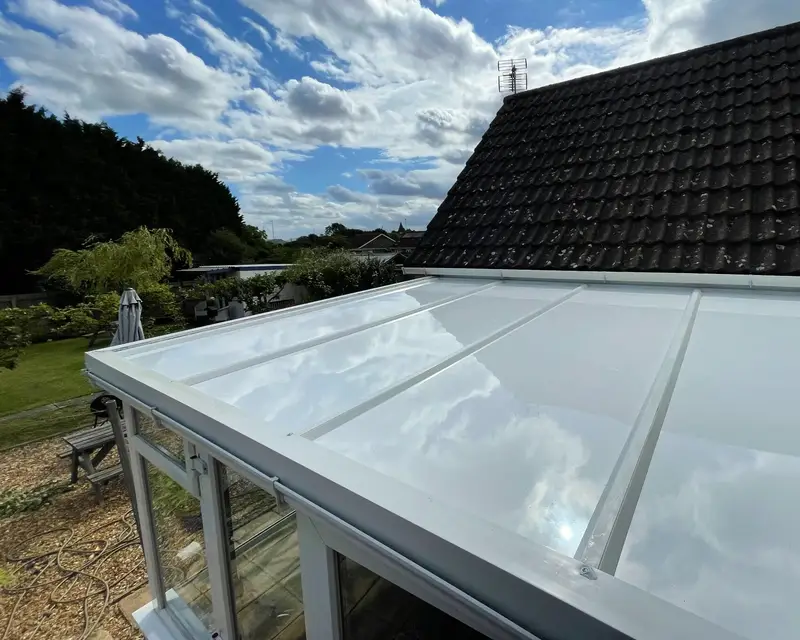
Five tests you can do from a step ladder
You do not need to go onto the roof. All of these work from inside the room, or from a ladder at the gutter end. Never stand or lean on the roof itself, whichever it turns out to be.
| Test | Polycarbonate | Glass |
|---|---|---|
| Tap it with a knuckle | A hollow, plasticky knock | A hard, clear clink |
| Look along the edge | Lots of thin ribs (flutes) in a row | Two panes and a spacer bar |
| Look through it | Blurred, milky, bronze or opal | A sharp view of the sky |
| Press gently from below | Gives very slightly | No give at all |
| Check the corner | Printed text along the sheet edge, if any | Often a small etched safety mark |
Reading the edge: flutes or a spacer bar
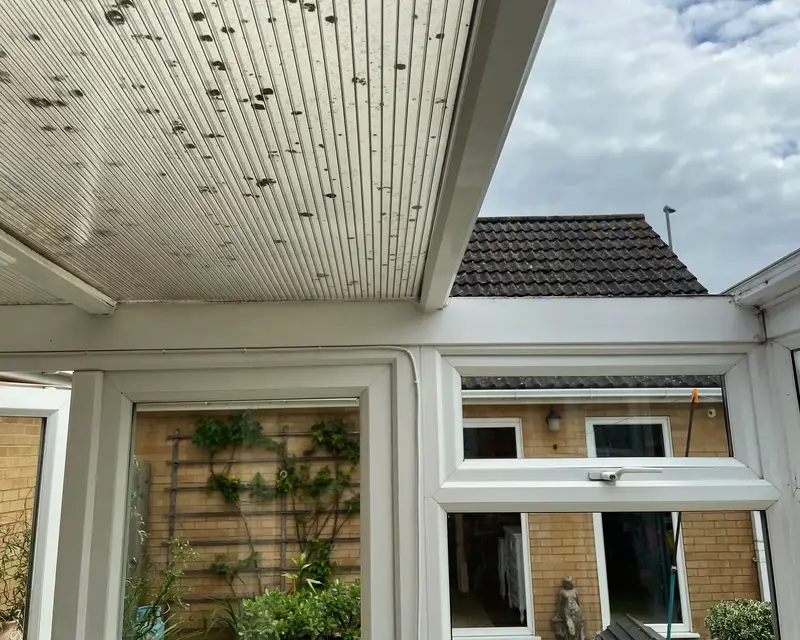
The edge is the clearest test. Multiwall polycarbonate is made like a honeycomb laid flat: two or more thin plastic walls joined by ribs every few millimetres, forming hollow channels called flutes that run from the ridge down to the gutter. From below you see them as faint stripes. On an older roof the stripes are easy to spot, because dirt and algae collect inside the flutes and show up as dark lines.
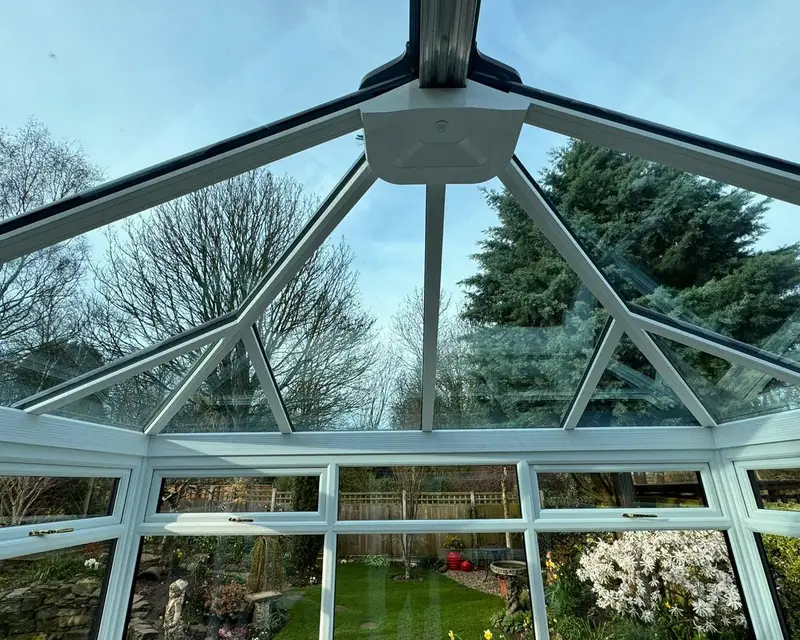
A double glazed roof unit is two separate sheets of glass held apart by a spacer bar, a narrow strip of aluminium or plastic sealed into the edge. You see it as a silver, grey or black band a centimetre or two wide running round the unit just inside the glazing bar. Some spacers have a date or a maker's code printed on them, which also helps with dating your roof.
Sound, flex and rain
Tap a panel lightly with a knuckle from inside. Polycarbonate answers with a dull, hollow knock, like tapping a plastic box. Glass gives a short, hard clink. If you have heard rain on the roof, that is another clue: a downpour on polycarbonate sounds like a snare drum, while glass stays quieter. Our page on conservatory roof rain noise explains why.
Flex is the last check. Press very gently upward on the middle of a sheet with a flat palm. Polycarbonate moves a fraction; a glass unit does not move at all. Do not push hard: an old sheet can be brittle, and a cracked glass unit is not something to lean on.
Why it matters for your quote
The two roofs behave differently and come off differently. Glass units are heavier and need more people to lift down safely. They also run hotter in summer: in our model a south facing room reaches 50°C at its hottest hour under older glass and 47°C under polycarbonate, against 34°C under a 75 mm panel roof.
Our quote form asks you to choose Polycarbonate, Glass or Not sure. If the tests above leave you torn, pick Not sure. The surveyor confirms it on the visit, so a wrong guess holds nothing up.
Mixed roofs and look-alikes
- Some bays glass, some polycarbonate. Common where one sheet broke years ago and was replaced with whatever was handy. Note which bays are which.
- Acrylic or thin corrugated sheet. Single skin, wavy, very light and often yellowed. Older lean-tos sometimes have it. Pick Polycarbonate for it on the form.
- Tinted or blue glass. Still glass. The tests above still apply; it simply looks darker.
- Glass with a film on it. A mirrored or tinted film on the inside does not change what the roof is made of.