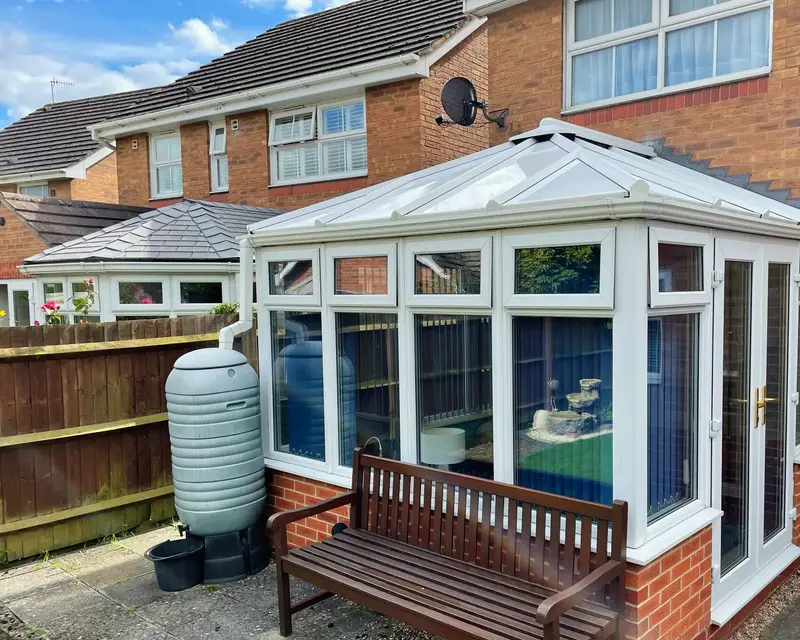
What a new polycarbonate roof does well
Polycarbonate has honest strengths. It is light, so any sound frame carries it without a second thought. It lets daylight pour in, softened by the twinwall or multiwall flutes. It is quick to swap, and a 35 mm sheet is a real step up from the thin 16 mm stuff many 1990s rooms were built with: about 1.4 to 1.6 W/m²K instead of 2.3 to 2.8.
If your sheets have split, gone brittle or turned the colour of weak tea, a re-sheet fixes the look and the leaks for a modest sum. Plenty of people with a north facing room, or one shaded by a big tree, are perfectly content with that.
The catch is that brand new polycarbonate still lets about half of the sunshine that lands on it straight into the room. Clean sheets can be worse than tired ones on that score, because the grime that used to filter a little light has gone.
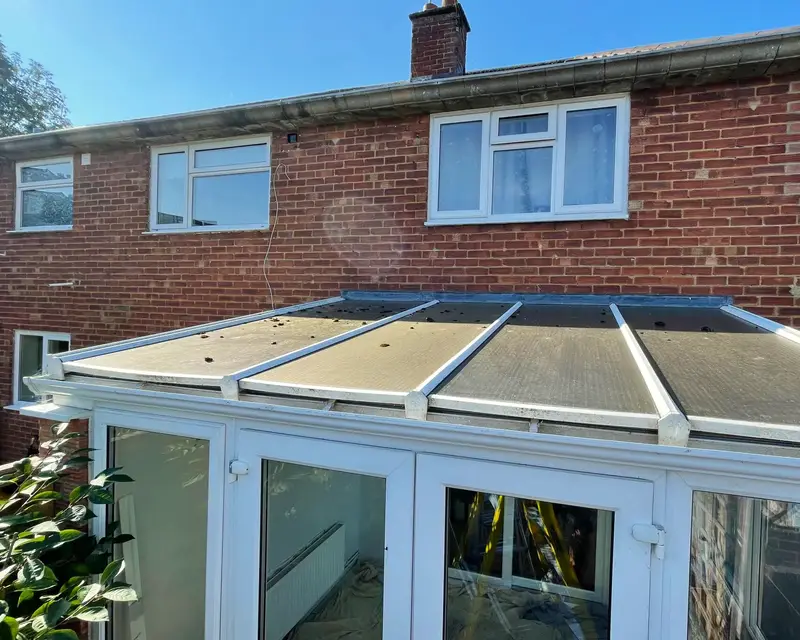
July is where the two roofs part company
Sunshine that gets through a clear roof turns into heat when it hits the floor, the sofa and you. A conservatory is mostly glass, so that heat leaves slowly. Put a solid, insulated lid on and the biggest heat source in the room simply stops at the ceiling.
The Comfort Calendar model runs one room, 14 m² floor (4.0 m by 3.5 m), three glazed sides, south facing, through two full years of hourly weather for 104 English towns. Under polycarbonate the hottest hour of the year averages 47°C. Under panels it averages 34°C. A typical July afternoon at 3pm sits at 33°C with the plastic roof and 25°C with the solid one. You can try your own town in the Comfort Calendar.
Winter: a real gap, but a smaller one
Here the numbers get more modest, and we would rather say so. A tired 25 mm polycarbonate roof sits at around 2.4 W/m²K; the panel roof is about 0.43. That sounds like a fivefold win, and for the roof alone it is. But the walls are still glass, so the room keeps losing heat through them.
In our model the roof is 41% of the heat loss of a polycarbonate conservatory. Swap it and the heater you need on a 0°C morning drops from 1.7 kW to 1.1 kW. Over a year of holding 19°C in waking hours, the bill falls by about 15%, roughly £65 on electric heating. Useful, not life changing.
- 1.7 kW
- heater for 19°C at 0°C outside, polycarbonate
- 1.1 kW
- same job under the panel roof
- £65
- yearly saving on electric heat
The two roofs, line by line
Prices here are broad, because every room is different; your figure comes after a survey. For the panel side, our guide prices by size and shape give the starting points.
| New polycarbonate | Insulated panel roof | |
|---|---|---|
| Cost | Lower of the two, often about half | From £3,000 for a small room |
| Winter warmth | U about 1.4 to 2.4 depending on thickness | U about 0.43 |
| Summer heat | 1,320 too-warm waking hours a year | 317 too-warm waking hours a year |
| Daylight | Bright and diffused from above | Light comes through the walls; roof lights optional |
| Rain noise | Drums in a heavy shower | A dull patter at most |
| Lifespan | Sheets often yellow or turn brittle within 10 to 20 years | Aluminium skins, 10 year guarantee |
| Upkeep | Moss and grime gather in the flutes | Smooth top skin rinses clean |
Rain, grime and the long run
Twinwall sheets work like a drum skin: a hard shower on twinwall can drown out a phone call in the next chair. The panel roof puts 75 mm of foam between the raindrops and your ears, which turns a downpour into background. If noise is your main complaint, our page on quieting rain noise on a conservatory roof goes further.
Polycarbonate also ages in a way you can watch. UV breaks down the surface, dirt gets into the flutes where no brush reaches, and the sheet you fit this year will likely look like the sheet you are replacing by the 2040s. Aluminium skins do not yellow, and the top is smooth, so a hose does most of the cleaning.
Which roof suits which room
There is no shame in choosing polycarbonate. It is the right call in some rooms, and the wrong one in others. Here is how we would split it. When you know which way you lean, start a free survey request and we will measure up.
New polycarbonate makes sense if
- The room faces north or sits in deep shade
- You mainly use it as a bright plant room
- Budget is tight and the roof is leaking now
- You are selling soon and want a tidy roof
Insulated panels make sense if
- The room faces south, east or west
- It is unusable from June to August
- Rain noise or glare drives you out
- You want it as a lounge, office or dining room