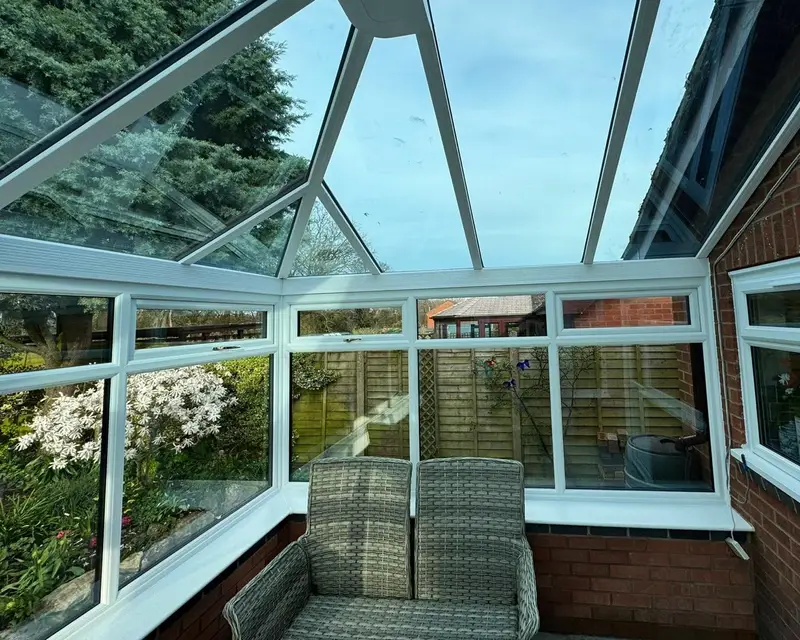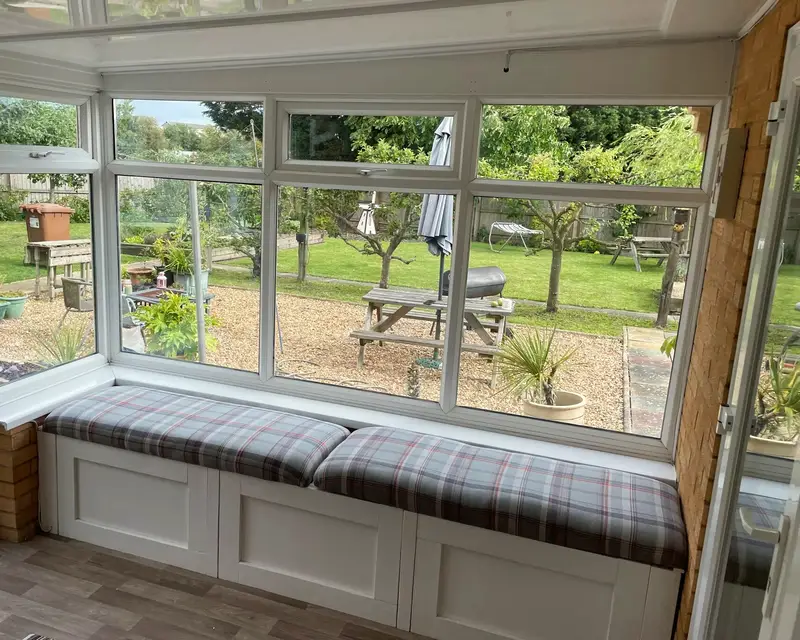
Why the room overheats so fast
Sunlight passes through the roof as light, hits the floor and the sofa, and turns into warmth. That warmth tries to leave as heat, which glass and polycarbonate are much better at holding back. So the room fills up like a bath with the plug in.
The second half of the story is air. Hot air rises and parks itself just under the roof, which is the one place with no windows to let it out. A ceiling fan only stirs that layer back down onto your head. By 3pm on an average July day our model has the polycarbonate room at 33°C and the glass room at 34°C, while the garden outside is usually somewhere in the low twenties.
For the longer version of the physics, see why a conservatory runs hotter than outside.
Test it at home with one thermometer
Feelings are unreliable after lunch, so put a number on it. A cheap digital thermometer with a memory does the job. Hang it at head height in the middle of the room, out of direct sun, because a thermometer sitting in a sunbeam reads the sunbeam, not the room.
Write down the reading at 9am, 1pm, 3pm and 6pm on a few clear days. If 3pm sits above 28°C with the doors open, ventilation will not save you. If the morning reading is already warm, the room is collecting heat from the day before and holding it overnight.
You can skip some of the waiting: the Comfort Calendar shows the hour by hour picture for your town under each kind of roof, worked out from two years of real weather.
A one week heat check
- Hang the thermometerHead height, centre of the room, shaded from direct sun.
- Read it four times a day9am, 1pm, 3pm and 6pm, on dry days with some sunshine.
- Note the doorsRecord whether doors and vents were open, so you can compare fairly.
- Find the tipping hourThe hour it first passes 25°C tells you how much of the day is lost.
Cheap things that take the edge off
None of these is useless, and none of them stops the sun landing on the roof. In rough order of value for money:
- Ventilate early. Open roof vents and doors at breakfast, before the room climbs, not at noon when it is already 30°C. Cross draughts beat fans.
- Shade the outside, not the inside. A blind under the roof catches the sun after it is already in the room. Anything shading the outer face, even a sail across the garden side, keeps more of it out.
- Reflective film. It knocks back some of the light and some of the heat, darkens the room and tends to peel or bubble on polycarbonate after a few summers.
- Move heat makers out. A fridge, a tumble dryer or a laptop charging on the windowsill all add their bit.
We compare these options properly against a new roof in roof blinds and film versus a new roof, and air conditioning gets its own page in air conditioning versus a new roof.
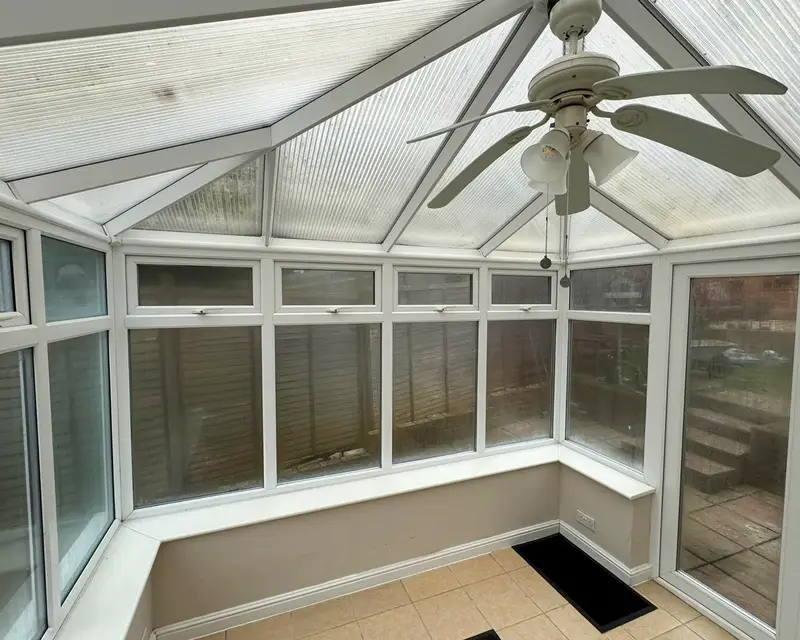
When only a different roof will do
You have reached the end of the cheap list when the room is above 25°C by late morning on most sunny days from May to September, even with everything open. At that point you are fighting the sun with a desk fan. The source of the heat is the roof material itself, and the only way to change what it lets through is to change what it is.
A dog, a baby or anyone who struggles in heat makes the case stronger. On a still July afternoon a closed polycarbonate room can pass 40°C, and our model puts the hottest hour of an average year at 47°C under polycarbonate and 50°C under glass. Pets left in a shut room are the first to suffer.
What the panel roof changes, and what it does not
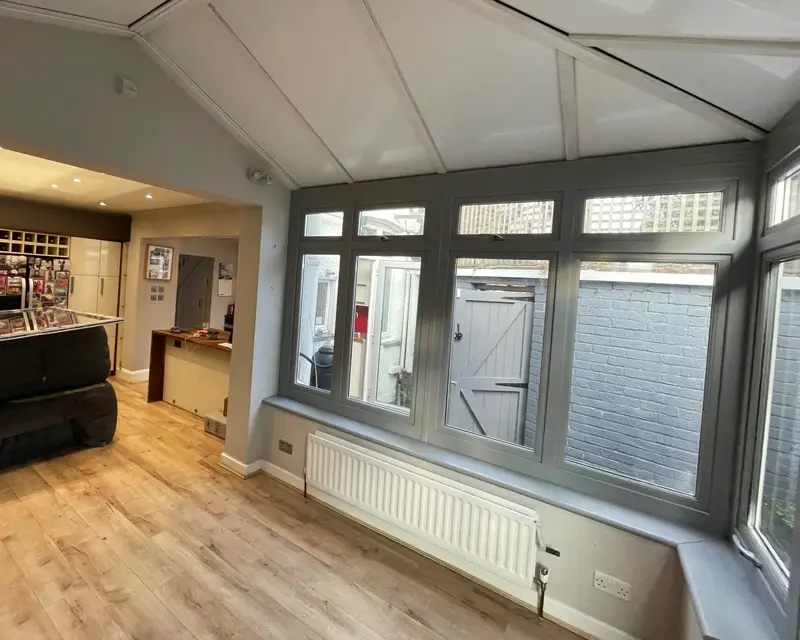
The panel roof is 75 mm of insulating foam between two aluminium skins. Sun hits the top skin, warms it, and very little of that warmth gets through the foam to the ceiling below. Light still comes in through the glass walls, so the room is lit from the sides instead of cooked from above.
Across our 104 towns, the too-warm hours fall by 76% and the hours above 30°C drop from 556 to 34. The hottest hour of the year comes down to around 34°C.
Now the honest part. The walls are still glass, so a south facing room still warms on a bright afternoon, and 317 warm hours a year is not zero. You will still want a window open in a heatwave. And the room is less bright overhead, which some people miss for the first week. Our guide prices start at £3,000 for a small room.
- 47°C
- hottest hour under polycarbonate
- 34°C
- hottest hour under the panel roof
- 76%
- fewer waking hours above 25°C
Before and after, same frame
The frame and the glass walls stay where they are. The old sheets come off, the bars are checked, and the panels go on, usually over one or two days. If you would like a fixed price for your room, start your quote here. Nothing is paid before the free survey.