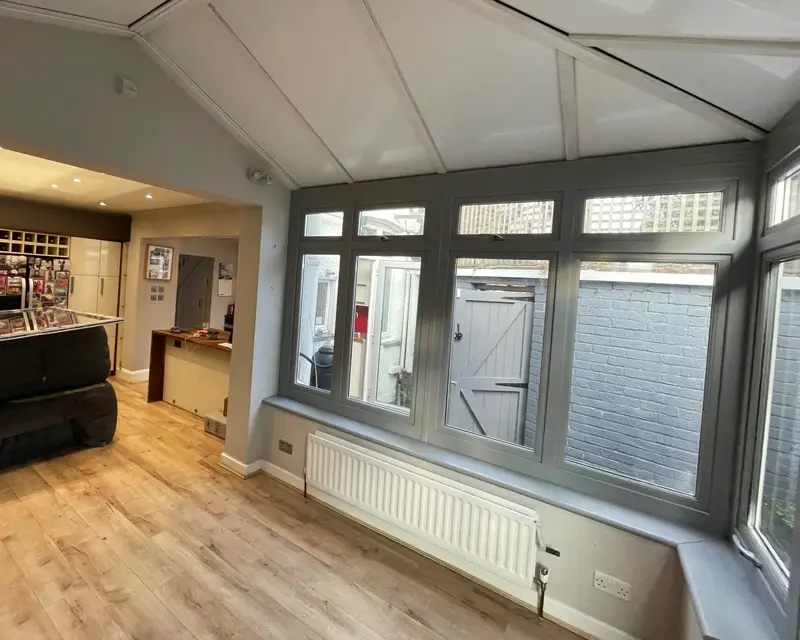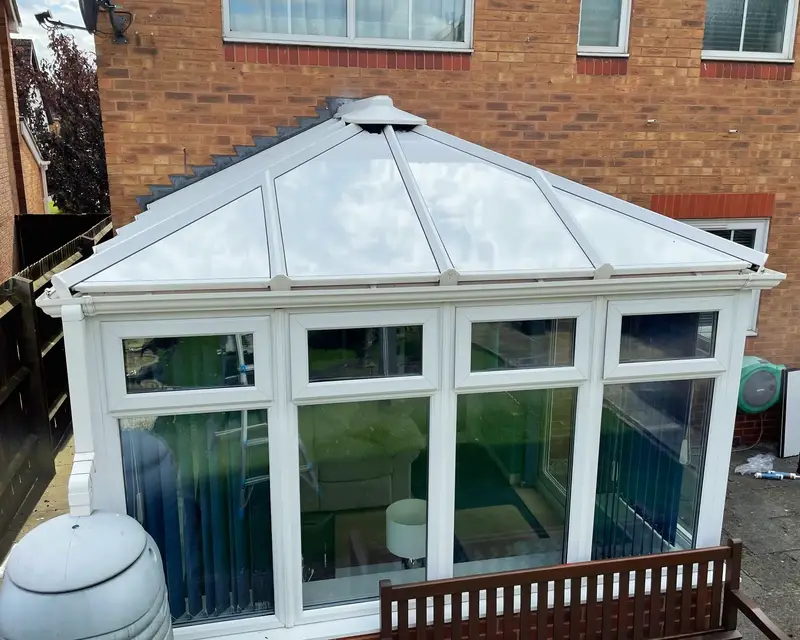
What changes, in four numbers
Each figure averages 104 towns over 2024 and 2025 with only the roof changed, in the same room with a 14 m² floor (4.0 m by 3.5 m), three glazed sides, south facing. The Comfort Calendar shows the same comparison for your own town.
| Polycarbonate | Glass | Panel roof | |
|---|---|---|---|
| Waking hours above 25°C | 1,320 | 1,467 | 317 |
| Waking hours above 30°C | 556 | 714 | 34 |
| July, 3pm average | 33°C | 34°C | 25°C |
| Hottest hour of the year | 47°C | 50°C | 34°C |
Why foam beats a clear sheet in summer
A clear roof lets sunlight straight in, and the room does the rest. A panel roof stops it at the top skin. That aluminium skin does get warm in the sun, sometimes hot to the touch, but there is 75 mm of foam between it and the ceiling. With a U-value of about 0.43, very little of that warmth gets through, so the inside face of the ceiling sits within a degree or two of the room air.
The result is a room heated mainly by its walls, not its roof. That is a much smaller source of heat to fight.
Does the panel colour make a difference?
Some. A dark anthracite top skin in full sun runs well hotter than a white one. Our rough sums for a roof of this size, with this much insulation, put the extra heat getting through at somewhere around 150 watts on a bright afternoon. That is about as much warmth as one and a half old fashioned light bulbs, noticeable but small next to what a clear roof lets in. Pick the colour for the house, not the thermometer. The options are on the colours and finishes page.
What it fixes and what it leaves
Honest expectations save disappointment. The roof is the biggest heat source, not the only one. On an ordinary sunny June day the panel room tracks a few degrees above the garden and feels like a bright lounge. In a heatwave, when the air outside is already past 30°C, no roof can make the room cooler than that air without a machine doing the work. What changes is the gap: the room stays a few degrees above the garden instead of racing far past it, and it cools quickly once you open up in the evening.
Mostly fixed
- Midday heat coming through the roof
- The hot layer of air under the ridge
- Glare from overhead
- Rain drumming on the sheets
Still there
- Low evening sun through west facing glass
- Heat on a 30°C day with no breeze
- Warm air if every vent stays shut
- Glass walls losing heat in winter
Getting the most from a cooler roof
- Keep a high vent or window. Heat still comes in through the walls and needs a way out.
- Think before adding a roof light. A glazed panel brings back some sun, which is lovely in March and less so in July. A small one does little harm.
- Shade the west wall if you use the room in the evening. A blind on that side alone makes a difference.
- Open up at dusk on hot days, so the floor dumps its stored warmth before bedtime.
If the roof is the part you want to change, the guide prices start at £3,000 for a small lean-to, and the quote questions take a couple of minutes.