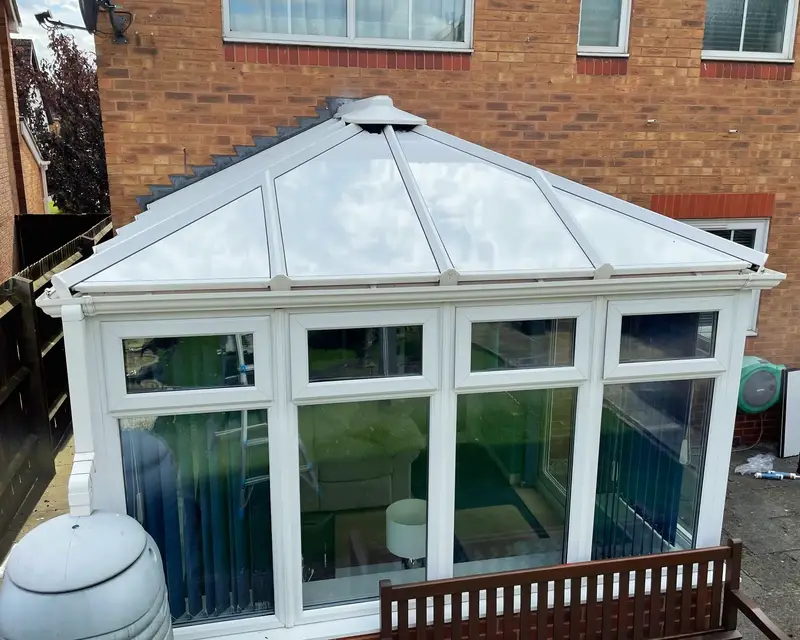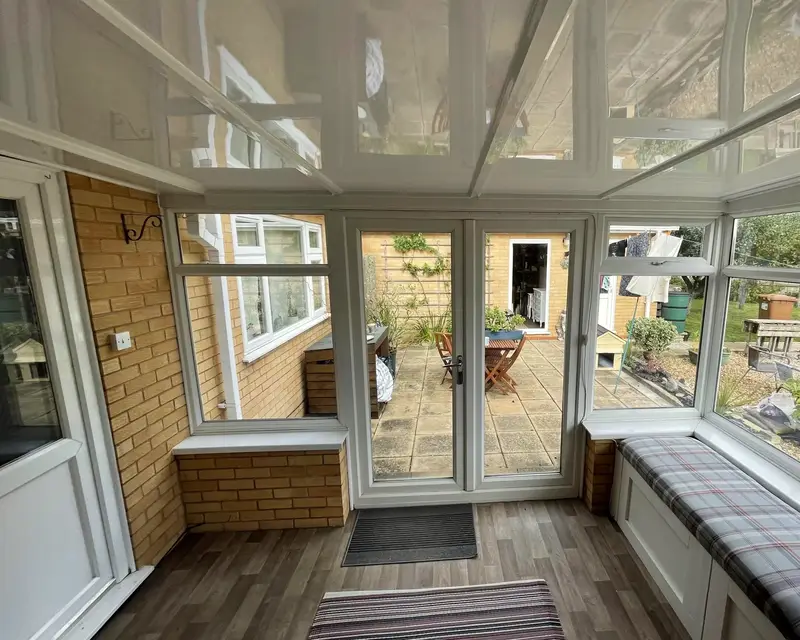
What the 10 years cover
If any of these fail through a fault in the product or in how we fitted it, we put it right at no cost to you:
- The panels. The 75 mm core and its aluminium skins, including delamination (the skins lifting away from the foam), warping and a finish that flakes or blisters.
- The seals. Every joint, cap and trim we sealed, where it meets the frame, the ridge or hub and the house wall.
- The workmanship. Fixings that loosen, panels that shift, gutters we fitted that drop or leak, and flashings along the wall plate.
The ten years start on the day of the walk round, and the paperwork you get that afternoon lists the roof, the address and the date.
Covered
- Panels: core, skins and finish
- Seals, caps and trims we fitted
- Our fixings and flashings
- Gutters we supplied and hung
Not covered
- Storm, impact or accidental damage
- Frames, walls and doors we did not work on
- Anything moved, drilled or altered by someone else
- Wear from pressure washing or harsh cleaners
What the guarantee leaves out, and why
A guarantee is a promise about our own work, so it stops where our work stops.
Damage is the big one. A branch through the roof in a gale, a ladder dropped on a panel, a football at speed: these are for your home insurance, not a product guarantee. It is worth telling your insurer you have a new roof so the cover reflects it.
Parts we did not touch are the second. The panels sit on your existing frame. We check it at the survey and make good what we find on the day, but the side frames, windows and doors stay under whatever cover they already had.
Changes made by others are the third. If someone else drills through a panel for a light, moves a gutter or fixes a satellite dish to the roof, the part they changed falls outside our cover. Ask us first and we can usually do the job, or tell you how to do it without breaking the seal.
What insurance backed actually means
Any firm can print ten years on a certificate. The question is who honours it if that firm is not around in year seven. With an insurance backed guarantee, an insurer stands behind the promise: if Warmlid stopped trading, you could still claim for a fault covered by the terms, and the insurer would arrange the repair.
It does not change who you call first. For as long as Warmlid is in business, the first call is ours and so is the repair. The insurer is the safety net underneath, not a call centre you have to deal with.
How a claim runs
- Tell usEmail a short note and two or three photos of the problem.
- We lookA reply comes inside two working days, plus a visit if the photos are not enough.
- We fix itCovered faults are repaired at no charge, at a time that suits you.
- If we cannotShould we ever stop trading, the insurer behind the guarantee takes the claim instead.
Looking after the roof: the whole routine
The top skin is smooth aluminium, so dirt has nowhere to hide the way it does in the flutes of an old polycarbonate sheet. That makes the yearly job short.
- Once a year, rinse it. A garden hose and a soft long handled brush, warm water and a drop of washing up liquid if it is grubby. Spring is a good time, after the leaves and before the pollen.
- Keep the gutters clear. A blocked gutter sends water back over the edge trim. November, when the last leaves are down, is the month to check them.
- No pressure washer on the joints. A jet can lift a seal in seconds. Keep it well away from caps, trims and the wall flashing.
- Skip the solvents. No bleach, no white spirit, no abrasive pads on the finish.
If you would rather not go up a ladder, a window cleaner with a water fed pole can do the roof from the ground in a few minutes.
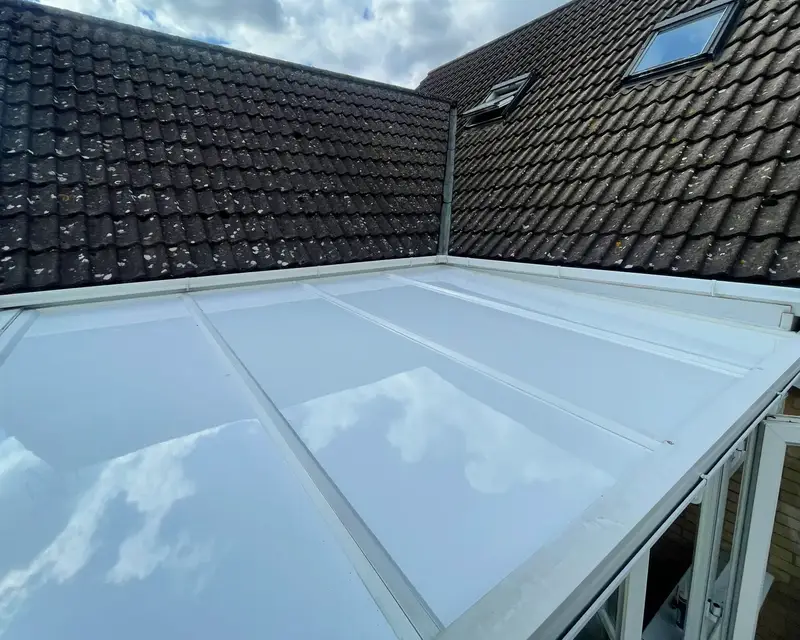
Inside: even less to do
The ceiling is a smooth white face that only needs a damp cloth if it ever gets marked. With the foam between it and the weather, the ceiling face sits only a degree or two below the air in the room, so it does not run with condensation in winter the way a cold sheet does. In our model, the roof alone is 41% of the heat loss of a polycarbonate conservatory, and swapping it means the heater you need on a freezing day drops from 1.7 kW to 1.1 kW. The Comfort Calendar shows what that looks like hour by hour where you live.
Want spotlights added later, or something from the fitting day changed? Ask us first. Spotlights go through the ceiling skin, and fitting them the right way keeps the guarantee intact.
How to report a problem
Email hello@warmlid.co.uk with your name, the address of the roof, the rough date it was fitted, what you have noticed and a few photos (one from outside, one from inside, one close up). A drip (our page on a dripping conservatory ceiling helps tell a leak from condensation), a loose trim, a stain on the ceiling: tell us early, because small faults are quicker to fix while they are small.
We acknowledge every report within two working days. If it is not something the guarantee covers, we say so and why, and give you a price if you want us to repair it anyway. Not satisfied with the way we dealt with it? Then our complaints page sets out what happens next.