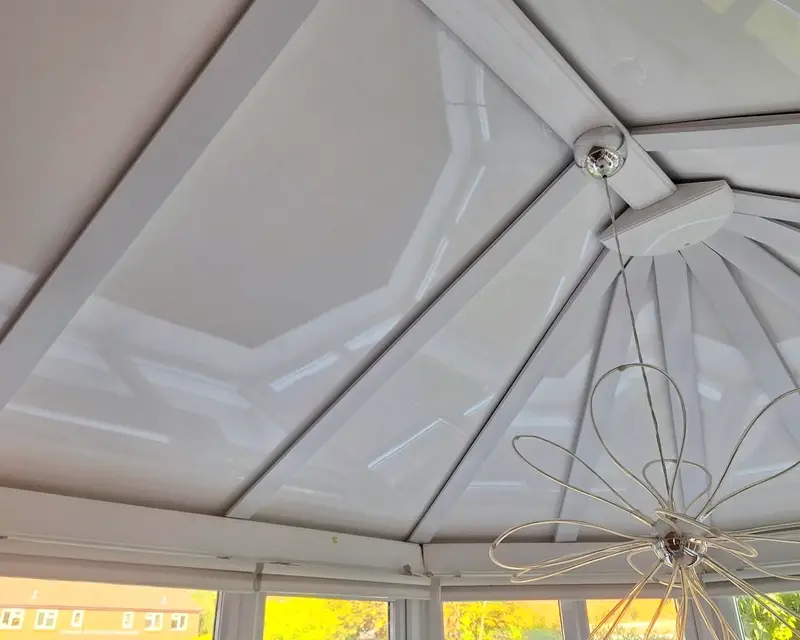
How much heat the sun pours in
On a clear July noon, around 700 to 800 watts of sunshine fall on each square metre facing the sky. A 15 m² roof catches over 10 kW. Polycarbonate lets about half of that through, and older glass a little more. Add the sun through the glass walls and a south facing room can be gaining heat faster than any domestic unit can remove it.
That is why the Comfort Calendar model shows the hottest hour of the year averaging 47°C under polycarbonate and 50°C under older glass, against 34°C under a solid 75 mm panel roof. Check your own town in the Comfort Calendar.
What air conditioning does well
Credit where it is due. A split unit, with an indoor head on the wall and a fan box outside, cools quickly, dries muggy air and works whatever the weather. It keeps every scrap of daylight. Most models also run in reverse as a heat pump, which in winter warms the room for roughly a third of the electricity a plug-in heater uses. That is a genuine advantage over a roof alone.
Portable units are a different animal. They vent hot air through a hose in a window gap, pull warm outside air back in to replace it, and rarely cope with a sunny conservatory. Our answer on whether air conditioning in a conservatory is worth it goes into the types.
Running costs at the current price cap
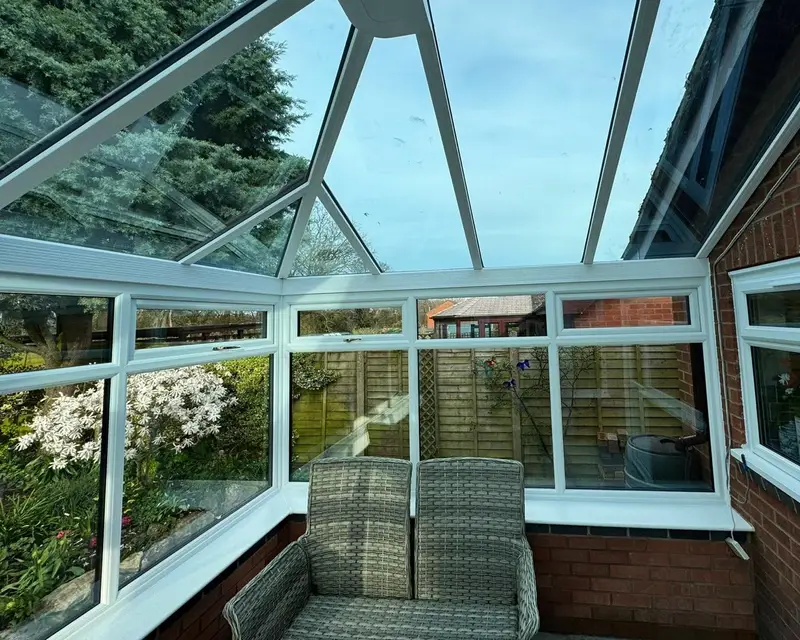
A unit cooling at 3.5 kW typically draws about 1 kW of electricity. At 26.32p per kWh that is roughly 26p for every hour it runs flat out, so every 100 hours of hard work costs around £26. Our model puts the room above 30°C for 556 waking hours a year under polycarbonate, before counting the warm hours below that line. A busy summer of cooling adds up, and the unit will still lose ground on the hottest afternoons.
Under a panel roof the same room only passes 30°C for about 34 waking hours a year, so a smaller unit can cope, or the doors and a fan may do. The fitted cost of a split unit is commonly in the region of £1,500 to £3,500, plus an annual service.
- 26.32p
- per kWh, price cap October to December 2026
- 556
- waking hours above 30°C, polycarbonate
- 34
- waking hours above 30°C, panel roof
Air conditioning and a new roof compared
The roof column has one quiet extra: it fixes leaks, rain noise and glare, which no cooling unit touches. Our conservatory roof replacement prices list the starting figures.
| Split air conditioning | Insulated panel roof | |
|---|---|---|
| Cost | Often £1,500 to £3,500 fitted, plus electricity | From £3,000, no running cost |
| Winter warmth | Efficient heat pump heating, roof still leaks heat | U about 0.43, smaller heater needed |
| Summer heat | Cools the air, struggles at peak sun | Sun stopped at the roof |
| Light | All daylight kept | From the walls, plus any roof lights |
| Noise | Fan hum inside and out, rain still drums | No machine noise, rain muffled |
| Lifespan | Often 10 to 15 years | Decades for aluminium skins, 10 year guarantee |
| Upkeep | Filters cleaned, yearly service | Rinse the top, clear gutters |
Using both together
The strongest setup for a room you want comfortable every month is often a panel roof with a small air to air heat pump. The roof takes away most of the summer load and the unit handles the few heatwave afternoons, then switches to cheap heating in winter. Because the roof has cut the heat loss, our model puts the heater needed on a freezing morning at 1.1 kW instead of 1.7 kW, so a modest unit is enough both ways.
If you plan both, do the roof first. Sizing a unit for a clear roof and then fitting a solid one leaves you with a machine bigger, louder and dearer than the room needs.
Doing both in the right order
- Survey the roofWe check the frame and measure for panels.
- Fit the panel roofThe main summer heat source goes.
- Live with it for a summerNote how often the room still gets too warm.
- Size the unit lastA cooling engineer can then pick a smaller, quieter model.
Our verdict
If you love the glass roof and can live with the running costs, a split unit is a reasonable choice, especially in a cooler town. If the room bakes every sunny afternoon, stop the heat at the roof first. Book a free roof survey and you can compare the figures side by side.
Air conditioning first if
- The roof is new, dry and you want to keep it
- The room faces east or north
- You want efficient winter heating as well
- Daylight overhead is not negotiable
A new roof first if
- The room tops 40°C on sunny days
- The roof leaks or drums in the rain
- You would rather not pay to run a machine
- You may add a small unit later anyway