Work out how much heat the room needs
A heater that is too small runs flat out and never catches up, and the room feels cold however long it is on. The figures below hold 19°C with the air outside at 0°C, in our model room with a 14 m² floor (4.0 m by 3.5 m), three glazed sides, south facing. A bigger room or a tired, draughty frame needs more.
Notice that the glass roof needs the most. The roof is 41% of all the heat lost from a polycarbonate conservatory, so what is overhead decides the heater size more than anything else.
The options, with running costs
Costs per hour are at full power on the 26.32p a kWh price cap. A heater with a thermostat cuts out when it reaches the set point, which brings the real evening figure down.
| Heater | Typical power | Per hour at full power | Best for |
|---|---|---|---|
| Fan heater | 2 kW | about 53p | Ten minute bursts |
| Oil filled radiator | 1.5 kW | about 39p | Steady evenings |
| Electric panel heater | 1 kW | about 26p | Background warmth |
| Infrared panel | 0.6 kW | about 16p | Warming whoever sits near it |
| Air to air heat pump | about 0.6 kW drawn for 1.8 kW of heat | about 16p | Daily use, and cooling in summer |
| Radiator on the central heating | From the boiler | Depends on your gas price | Rooms used whenever the house heating is on |
Why warm air heaters struggle under a clear roof
Fan heaters and convectors heat the air. Warm air rises straight to the roof, the coldest surface in the room, and gives up its heat there. You end up with a toasty layer under the sheets and cold ankles.
Radiant heat works differently. An infrared panel or halogen heater warms you and the furniture directly, so you feel it even when the air is cool. If you have a ceiling fan with a winter setting, running it slowly in reverse pushes the warm layer back down. Our page on heat loss through the roof shows why that top layer matters so much.
What we would pick
- Used every day: an air to air heat pump. Dearest to fit, cheapest to run, and it doubles as cooling in July.
- Used a few evenings a week: an oil filled radiator with a timer, switched on half an hour before you sit down.
- Used as a home office: a small infrared panel aimed at the desk, plus a low background heater.
- Already on the central heating: keep the radiator, but fit a thermostatic valve so it can be turned right down when the room is empty.
The hourly heating cost breakdown works through each outside temperature.
Stop the heat leaving before buying more of it
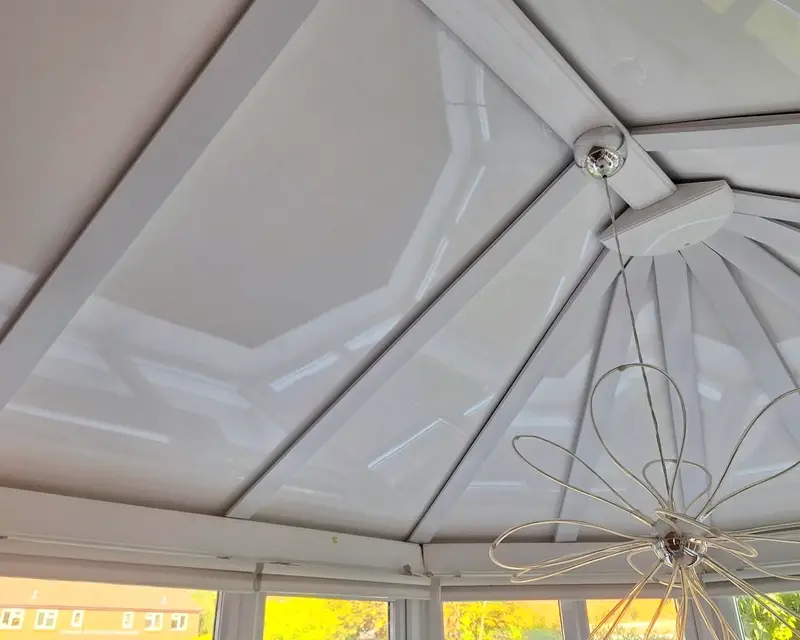
Lined curtains or thermal blinds drawn at dusk, a draught strip on the doors and a thick rug all help, and none of them cost much. The roof is the big one. Our model puts the yearly bill to keep the room at 19°C in waking hours at £433 under polycarbonate and £368 under a panel roof. Glass walls still lose heat, so the room still needs a heater, just a smaller one. Compare roof options on the insulation kit or new roof page.