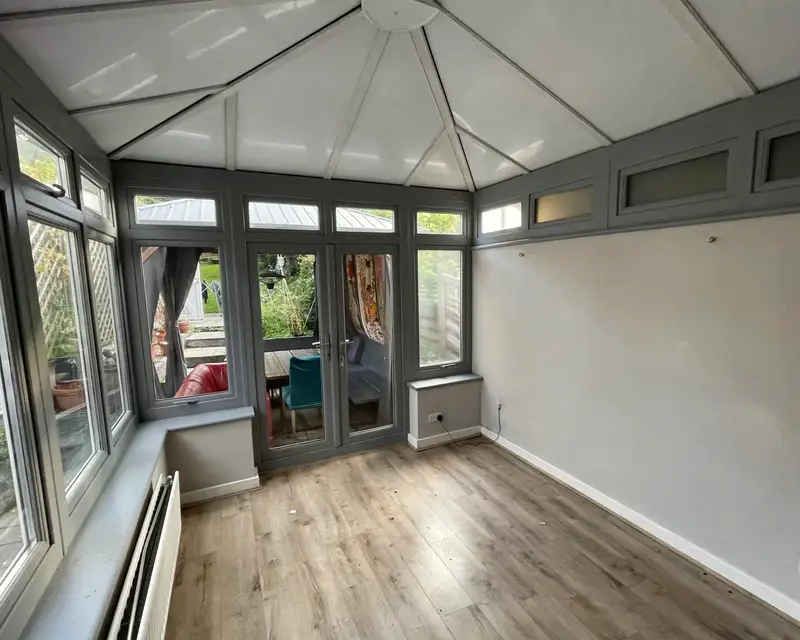
Overnight, it follows the garden down
We worked these from the same heat loss figures the Comfort Calendar uses: 14 m² floor (4.0 m by 3.5 m), three glazed sides, south facing, the house side kept at 19°C, no heating, no sun, and the room left long enough to settle. Real rooms do a little better early in the night because the floor slab gives back the warmth it soaked up in the day. By dawn, that store is mostly spent.
The gap between the two roofs is small here, one or two degrees. An unheated room with three glass walls is going to be cold whatever is on top. Anyone promising a toasty unheated conservatory in January is selling you something.
| Outside | Polycarbonate roof | Panel roof |
|---|---|---|
| 5°C | about 7°C | about 8°C |
| 0°C | about 3°C | about 4°C |
| Minus 5°C | about minus 2°C | about 0°C |
Daytime depends on whether the sun shows up
On a grey January day the room barely lifts off its morning low. On a clear one, a polycarbonate or glass roof soaks up low sun and the room can climb into the low to mid teens by mid afternoon, then lose it all within a couple of hours of sunset.
A panel roof does not collect that sun, so an unheated panel room has a flatter, cooler afternoon. That is the honest trade: you give up a few warm winter afternoons and get far fewer roasting summer ones. Once you heat the room, the panel roof is the cheaper one to keep warm.
Where the warmth escapes
In our model room under a tired 25 mm polycarbonate roof (U-value 2.4), the roof accounts for 41% of all the heat lost. The glass walls take about the same again. The dwarf wall and draughts share the rest.
Put a 75 mm panel roof on (U-value 0.43) and the roof share shrinks to a sliver. The walls are untouched, which is why the room still needs a heater.
What holding 19°C costs
At 0°C outside, the polycarbonate room needs 1.7 kW of heat running constantly to stay at 19°C. On a plain electric heater at 26.32p a kWh, that is about 45p an hour. Under a panel roof the heater drops to 1.1 kW, about 29p an hour. Over a whole year of waking hours our model puts the bill at £433 under polycarbonate and £368 under panels, a 15% saving.
There is a full working of hourly costs at different outside temperatures in what a conservatory costs to heat per hour.
When cold becomes a problem
- Condensation. Cold glass and cold roof sheets are where moisture from the house ends up. Water running down the glass every morning means mould in the corners by March.
- Plants. Citrus, geraniums and most succulents dislike anything under 5°C. On a minus 5°C night an unheated room can get there.
- Pipes and appliances. A washing machine or outside tap in the conservatory needs a frost guard heater set to about 5°C.
- Furniture. Leather and wood move with damp cold. Upholstery near the glass can pick up a musty smell; there is more on that in why conservatories smell damp.
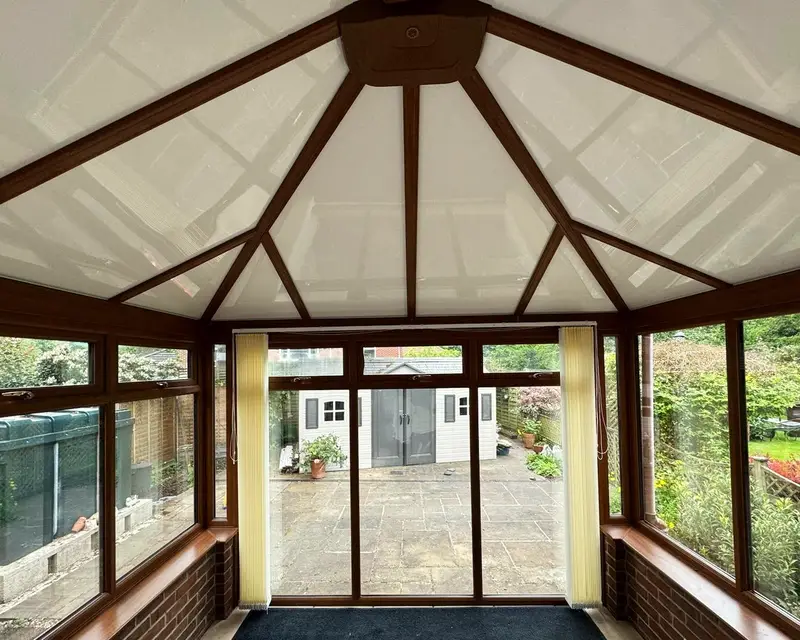
What a new roof changes in winter
If the room is cold because the roof is the weak spot, the cold conservatory fixes page sets out the options from cheapest up.
Polycarbonate roof in winter
- 1.7 kW heater to hold 19°C at 0°C outside
- Cold air drops off the roof onto your shoulders
- Sunny afternoons give a free lift
- Rain and hail drum overhead
Panel roof in winter
- 1.1 kW heater does the same job
- The ceiling is about as warm as the room, so no downdraught
- Sunny afternoons give little extra
- Glass walls still need curtains or blinds at night