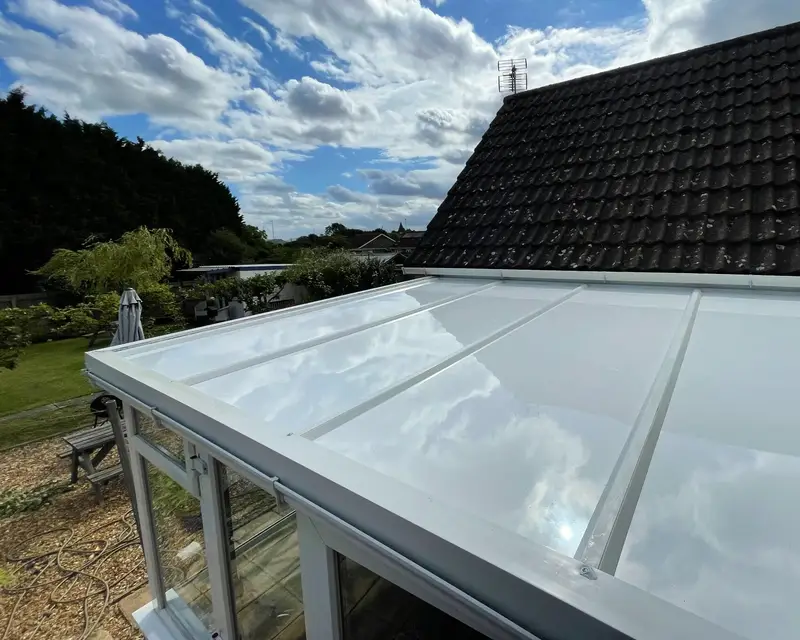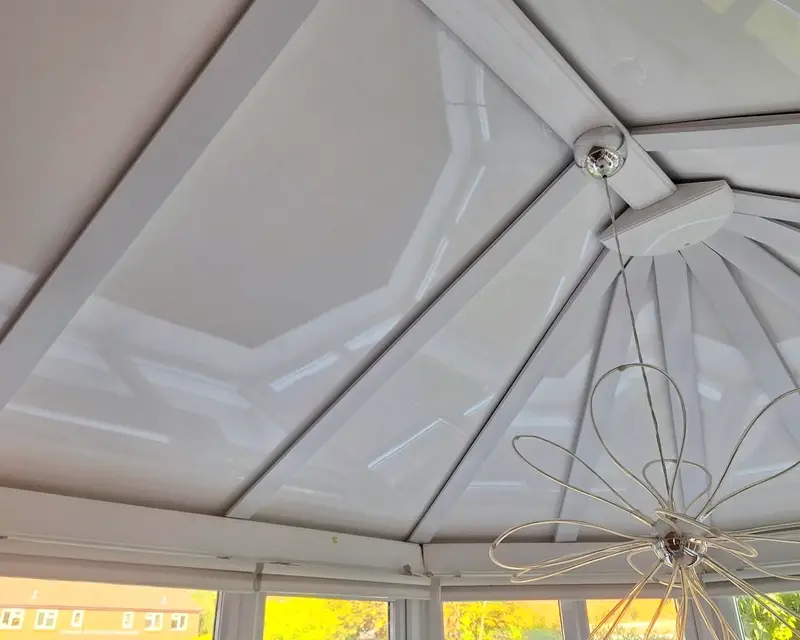
Where the heat goes in a typical conservatory
Heat leaves a room through every surface, in proportion to two things: how big the surface is and how poor it is at holding heat back. That second number is the U-value: how many watts one square metre lets through when it is one degree warmer on one side than the other. Lower is better.
The room in our model has 15.4 m² of roof, 13.2 m² of glass wall on three sides, a low brick dwarf wall and the house wall at the back, which is kept at 19°C by the house. Here is how the loss splits on a cold evening:
| Polycarbonate roof | Panel roof | |
|---|---|---|
| Roof | 41% | 11% |
| Glass walls | 41% | 61% |
| Air leaking in and out | 10% | 16% |
| Brick dwarf wall | 8% | 12% |
Watts lost through the roof alone
Multiply U-value by area by temperature difference and you have the watts. At 19°C inside and 0°C outside, with our 15.4 m² roof:
Roof U-values compared
Not every roof is as poor as the one in our model. Thicker polycarbonate and modern low-e glass do better, though none come close to a solid insulated roof. These are typical ranges; an old sheet with failed seals and water in its flutes sits at the bad end of its range.
- 16 mm polycarbonate: about 2.3 to 2.8
- 25 mm polycarbonate: about 1.6 to 2.4, depending on condition
- 35 mm polycarbonate: about 1.4 to 1.6
- Double glazed roof units from the 1990s and 2000s: about 2.8
- Modern low-e roof glass: about 1.2 to 1.6
- Insulated panel roof: about 0.43
A U-value of 0.43 is good for a lightweight roof, but it is not as good as a modern brick wall or loft, and we will not pretend otherwise. If you are not sure which kind you have, our page on telling polycarbonate from glass walks you through it.
What it costs you over a winter
To keep the model room at 19°C through the waking hours of an average year takes about 1,646 kWh under polycarbonate. At the 26.32p per kWh electricity cap, that is £433 a year with plug in heaters. Under a panel roof it is 1,400 kWh, or £368.
That 15% saving, about £65 a year, is smaller than the 33% cut in heater size, and the reason is worth knowing. A clear roof leaks heat at night but also collects free sun on bright winter days. The panel roof stops both, so some of the warmth it holds in is offset by sunshine it no longer lets through. The bigger gains are comfort and summer: the room warms faster, holds heat after the heater goes off, and loses most of its overheating hours. The Comfort Calendar shows both seasons for your town.
- 1.7 kW
- heater to hold 19°C at 0°C outside, polycarbonate roof
- 1.1 kW
- the same room with a panel roof
- £65
- a year saved on electric heating, model average
The part a roof cannot fix
After the roof, the glass walls are the biggest heat path, and a panel roof leaves them exactly as they were. Draughts around doors and trickle vents, gaps where the frame meets the house, and a cold floor slab all carry on. That is why a panel roof makes a conservatory warmer and calmer, not a sealed extension. If cold is your main complaint, start with our page on fixing a cold conservatory, which covers the cheap draught fixes as well as the roof.