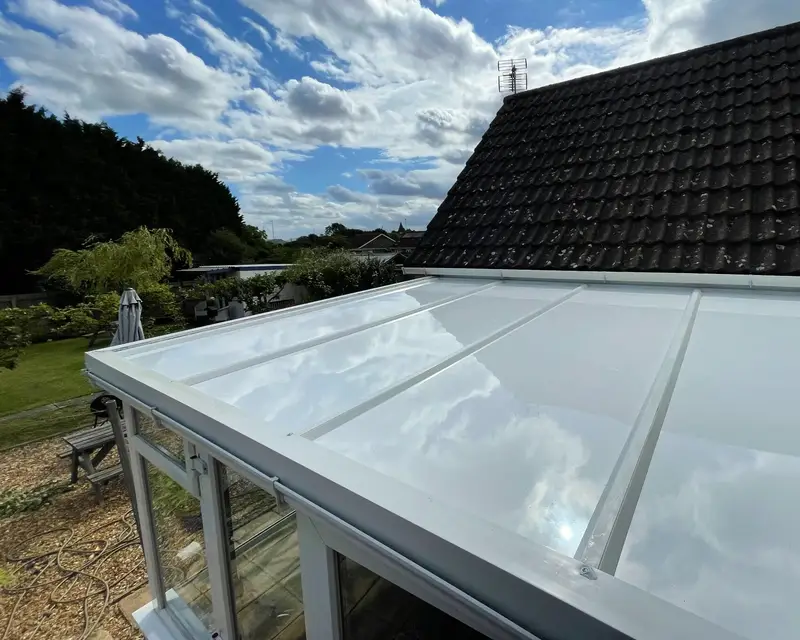
What roof blinds really do
Pleated and cellular roof blinds sit in tracks just under the glazing. Good ones have a reflective backing that sends part of the light straight back out. They are brilliant at one job: softening the hard, white light that makes a screen unreadable and leaves you squinting. They also give privacy from upstairs windows next door.
Heat is the weaker point. The sun's rays get through the glazing first, then land on the fabric and heat it up. The blind then warms the trapped air above it and radiates into the room below. The reflective share escapes; the rest stays. On a bright July day the room still climbs, just a little more slowly. Our page on sorting out glare in a conservatory has more on the light side.
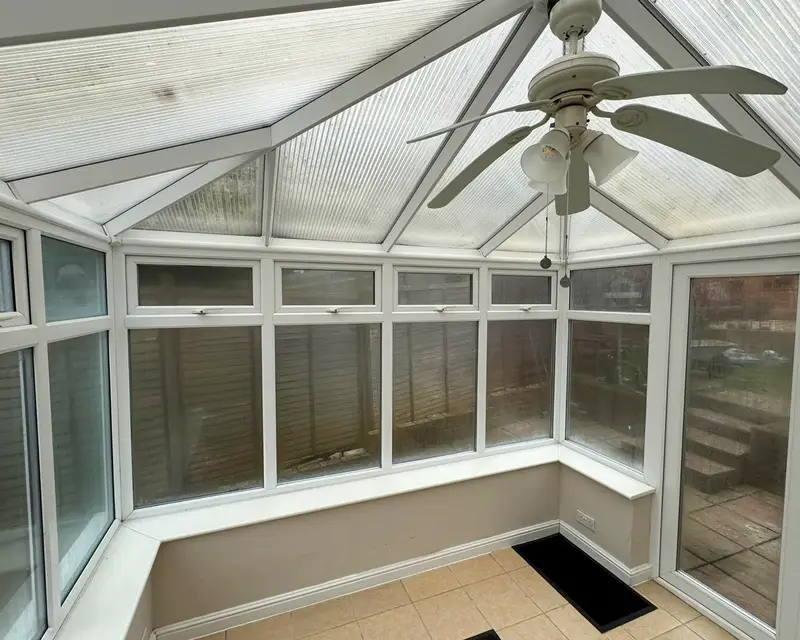
Solar film: good on glass, awkward on plastic
A reflective or tinted film stuck to the inside of a glass roof turns sunshine back before it gets in, which beats a blind for heat. A good film on clear glass can make a real dent in afternoon temperatures, and you keep a view of the sky, if a darker one.
On polycarbonate it is a different story. The surface is ribbed or fluted, the plastic flexes and expands, and most film makers advise against using it there. Films can also make a sealed glass unit run hotter, so check the glass supplier's guidance before fitting one. And a filmed roof never lets you open it up for a bright winter day: the tint stays all year.
What the thermometer says
Our Comfort Calendar model does not include blinds, because how much they help depends on fabric, colour and whether you remember to close them. It does compare the roofs themselves. Under polycarbonate the room averages 33°C at 3pm in July and peaks at 47°C in the hottest hour of the year. Under a 75 mm panel roof those figures are 25°C and 34°C.
A blind narrows the gap between those columns; it does not close it. Look up your own town in the table of the hottest towns for conservatories to see how big the gap is where you live.
- 33°C
- July 3pm under polycarbonate
- 25°C
- July 3pm under the panel roof
- 34
- waking hours above 30°C under panels
Blinds, film and a new roof in one table
Blinds and film leave the roof itself alone, so leaks, moss and noise carry on as before. For the panel side, see the guide prices for each size.
| Roof blinds | Solar film | Insulated panel roof | |
|---|---|---|---|
| Cost | Often four figures for a whole roof | Usually less than blinds, glass only | From £3,000 |
| Winter warmth | A little at night when closed | Little or none | U about 0.43 |
| Summer heat | Slows the rise, sun already inside | Turns some sun back at the glass | Sun stopped at the roof |
| Light | You choose: open or shaded | Tinted all year | From the walls, plus any roof lights |
| Rain noise | No change | No change | Muffled |
| Lifespan | Fabric fades, cords and motors wear | Can peel or bubble over time | 10 year guarantee |
| Upkeep | Dust, flies, the odd stuck track | Gentle cleaning only | Rinse the top now and then |
The money over ten years
A full set of made to fit roof blinds for a medium conservatory can run well into four figures, with motorised ones more. That buys you better light and some comfort on top of the same old roof. If that roof is due for replacement within ten years anyway, much of the spend comes down with it, since blinds sized for one roof rarely fit the next.
A panel roof costs more on day one, but it fixes heat, noise, glare and leaks together, and in our model it adds about 1,003 usable waking hours a year. You can still have a blind or two on the walls if the evening sun bothers you.
Our verdict
If the room is only too bright, not too hot, blinds are the cheaper fix and we would say so. If it is too hot to sit in, the heat needs stopping at the roof. Either way, start with a free survey and you will have a firm price to weigh against a blind quote.
Blinds or film are enough when
- The roof is sound, dry and not very old
- Glare bothers you more than heat
- The room faces north or is well shaded
- You want privacy from overlooking windows
A new roof is worth it when
- The room tops 35°C on sunny afternoons
- The roof leaks, drums or has gone yellow
- You would be buying blinds for a failing roof
- You want heat, noise and glare fixed at once