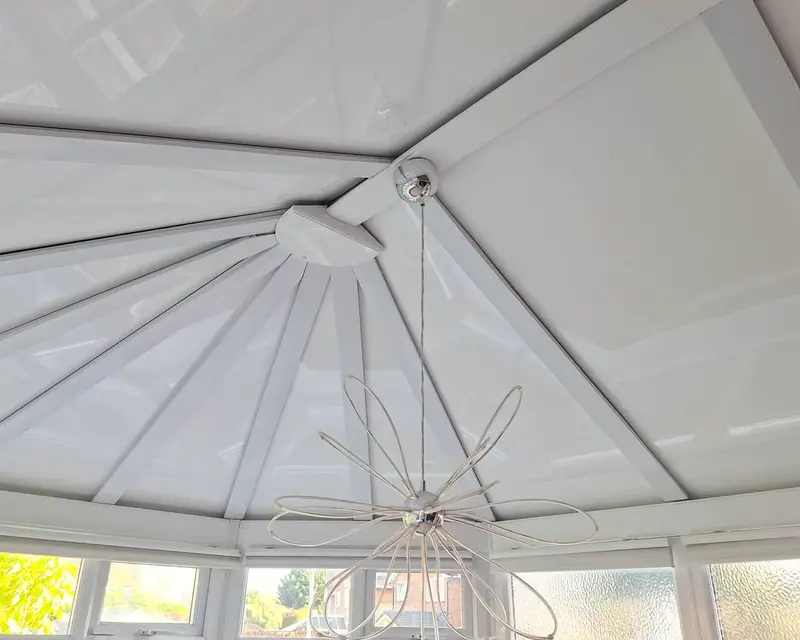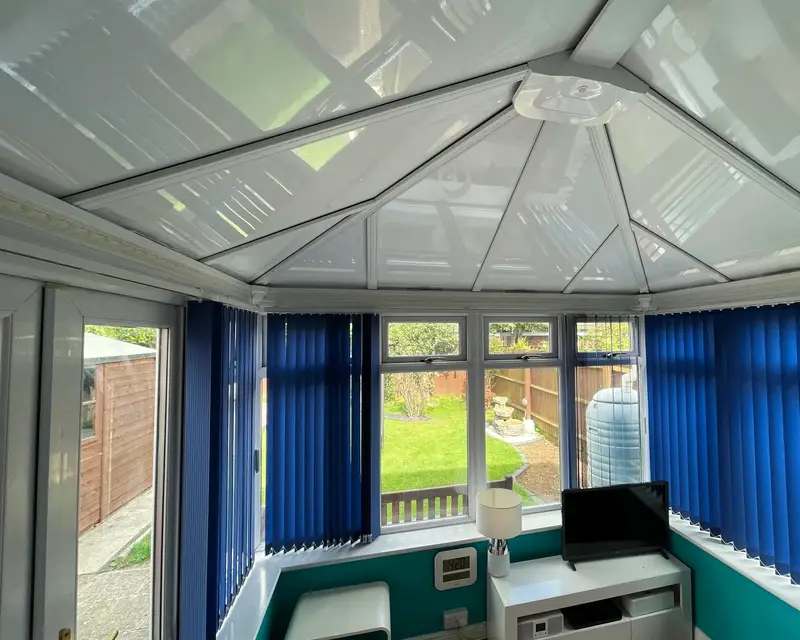
Light in, heat stuck
Sunlight is mostly short wave energy, which passes through glass and polycarbonate with little trouble. When it hits a sofa, a rug or the floor slab, those surfaces warm up and give the energy back as long wave heat, the kind you feel from a radiator. Glazing is far less see-through to that long wave heat, so it builds up inside. A car parked in the sun works the same way, and so does a greenhouse.
The second half of the trap is the air. Outside, a breeze carries warmth away from a sunny wall. Inside a closed conservatory the air barely moves, so the heat stays put until a door or window is opened.
How a sunny hour becomes a hot room
- Sun reaches the roofIn June the midday sun stands about 60 degrees above the horizon in southern England, so it falls almost straight onto a gently sloping roof.
- Light passes throughThe roof sheet lets a share of that energy straight in. Builders call the share the g-value.
- Surfaces soak it upThe floor, furniture and dwarf wall absorb the light and warm up.
- Heat comes back off themWarm surfaces radiate long wave heat, which the glazing holds in far better than it let the light in.
- Still air holds itWith the doors shut, nothing carries the warmth away, so the temperature keeps climbing until mid afternoon.
Why the roof matters more than the walls
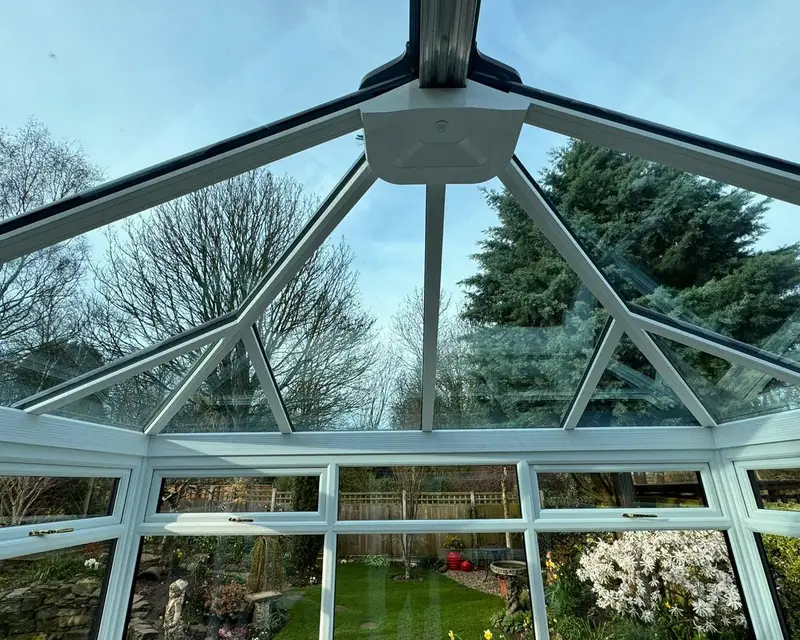
An upright wall catches the summer sun at a glancing angle. A roof faces the sky and catches it nearly head on, for longer each day. In the Comfort Calendar model, a polycarbonate roof lets through half of the sun that falls on it (a g-value of 0.5) and an older double glazed roof about 0.62. Across the 14 square metre floor of our test room, that makes the roof responsible for roughly three quarters of all the solar heat entering the room.
An insulated panel roof has a g-value of zero: no light passes through 75 mm of foam and two aluminium skins. The walls still bring sunshine in, so the room stays bright and warms nicely on a clear spring morning, but the overhead firehose is turned off. You can see what that does to your own town by picking it in the Comfort Calendar, and how we arrived at the numbers on how we model it.
| Share of sun let through (g-value) | Heat loss (U-value, W/m²K) | |
|---|---|---|
| Glass roof, 1990s or 2000s | 0.62 | 2.8 |
| Polycarbonate, tired 25 mm | 0.5 | 2.4 |
| Insulated panel roof | 0 | 0.43 |
What solar gain does over a whole year
Our model counts the waking hours, 8am to 10pm, when the room sits above 25°C with the doors shut until it gets there. Averaged over 104 English towns and two years of hourly weather, a south facing room clocks up 1,320 of those hours under polycarbonate and 1,467 under glass. Under a panel roof the figure is 317, a cut of 76%.
That is not only July. A clear March afternoon can push a south facing polycarbonate room past 25°C while the garden is at 10°C, which is why people find the room unusable for lunch in spring and then freezing by 6pm. Our overheating league table ranks every town we modelled; the hottest is Hounslow.
Is any solar gain good?
Yes, and it is fair to say so. On a bright winter day, free heat from the sun takes the chill off a room that would otherwise need a heater. A panel roof gives up some of that winter bonus along with the summer excess, which is one reason the winter heating saving in our model is real but modest at 15%, about £65 a year on electric heating. The glass walls keep a good share of the low winter sun, because in December it comes in sideways rather than from above.
The trade most people want is exactly that: keep the low, gentle sun through the walls and lose the high, harsh sun through the roof.
Ways to cut solar gain, from cheapest up
- Open up early. Doors and roof vents opened before the room warms up do more than opening them at 3pm.
- Shade outside rather than inside. An external awning stops the sun before it becomes heat; an internal blind stops it after, so the heat is already in the room.
- Film and blinds on the roof. They take the edge off glare and some heat, though the sheets still heat up and radiate downward. We compare them on blinds and film against a new roof.
- A solid roof. The only option that takes the roof out of the solar gain sum altogether.