The right number depends on the job
A conservatory gets used for more things than most rooms, and each one has its own comfortable range. These are the figures we work to, in line with the usual UK health advice that living spaces should be at least 18°C in cold weather.
| Use | Aim for | Worth knowing |
|---|---|---|
| Sitting and reading | 18 to 21°C | Sun on your back adds a couple of degrees of feel |
| Working at a desk | 19 to 21°C | Screens wash out in strong overhead light |
| Dining | 19 to 21°C | A full table warms the room by itself |
| Sleeping | 16 to 18°C | Summer nights under a clear roof rarely get there |
| Tender plants in winter | 7 to 10°C | Citrus and pelargoniums sulk below that |
| Empty in winter | 5°C or more | Enough to keep frost off pipes and pots |
Why 25°C is where we draw the line
Somewhere between 24 and 26°C a still room stops feeling pleasantly warm and starts feeling close. You notice it sooner if you are sitting in sun, wearing a jumper or trying to concentrate. Our Comfort Calendar counts every waking hour above 25°C as too warm, and hours above 28°C as too hot.
By that measure, the roof overhead decides most of the summer. Glass is worst, polycarbonate a little better, and an insulated panel roof cuts the count by 76%.
Holding a steady temperature is the hard part
Reaching 20°C is easy. Staying there is not, because a glazed room swings with the weather far faster than a brick one. A cloud passing over a polycarbonate roof can change the room by a degree in minutes.
- Put the thermostat in the shade. A heater thermostat sitting in a sunbeam switches off early, then the room drops when the sun goes in.
- Heat before you sit down. Twenty minutes ahead is enough for a small room. Heating an empty conservatory all day mostly warms the garden.
- Close the blinds at dusk. Bare glass at night feels cold even when the air is at 20°C, because your body radiates warmth towards it.
- Open a high vent before it overshoots, not after. Once a room passes 28°C it takes a long time to come back.
The winter minimum, and why it is not zero
Letting an empty conservatory go as cold as it likes saves money, but a room sitting at 2 or 3°C for weeks gathers condensation on every cold surface. A frost guard setting of 5 to 8°C keeps water off the frames and the damp smell at bay for not much electricity. More on that in why a conservatory smells damp, and for plants, see what grows under a solid roof.
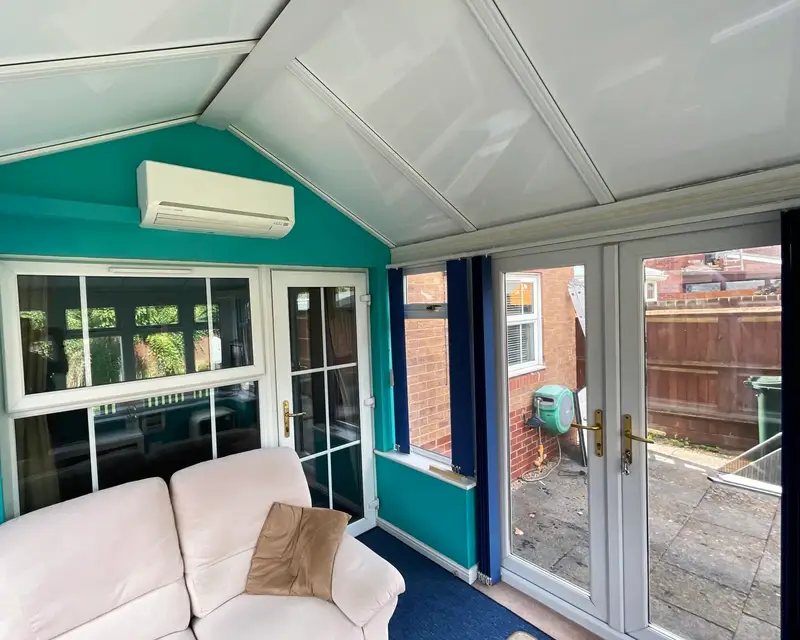
How the roof moves the range you can hold
Under a polycarbonate roof you are working at both ends: heating hard in winter, venting hard in summer. The panel roof narrows the swing. Our model needs a 1.1 kW heater to hold 19°C on a freezing day instead of 1.7 kW, and the summer peak drops from 47°C to 34°C. The room becomes one you can set to a number and leave. The prices page has guide costs by size.